
Nichols MSIT
SUNY Canton CARC
Rockwell Hall
Hallwalls
Sheltered Workshop
BPS 17
East Canal
South Buffalo BOA
U Building
SUNY IT
Mason Hall
Buffalo Public Library
Ellicottville Library
BNMC Bridge
BNMC Master Plan
Bronx Children’s PC
Queens CSB
Grant St. PC
Wine Merchant
SLR Bison’s Suite
North Union Street
SUNY Canton FMP
Praxair
Harris Beach
Lippes
700 Main Stokes
Niagara River District
Fulton Brownfield
Gateway Point
Binghamton Science 5
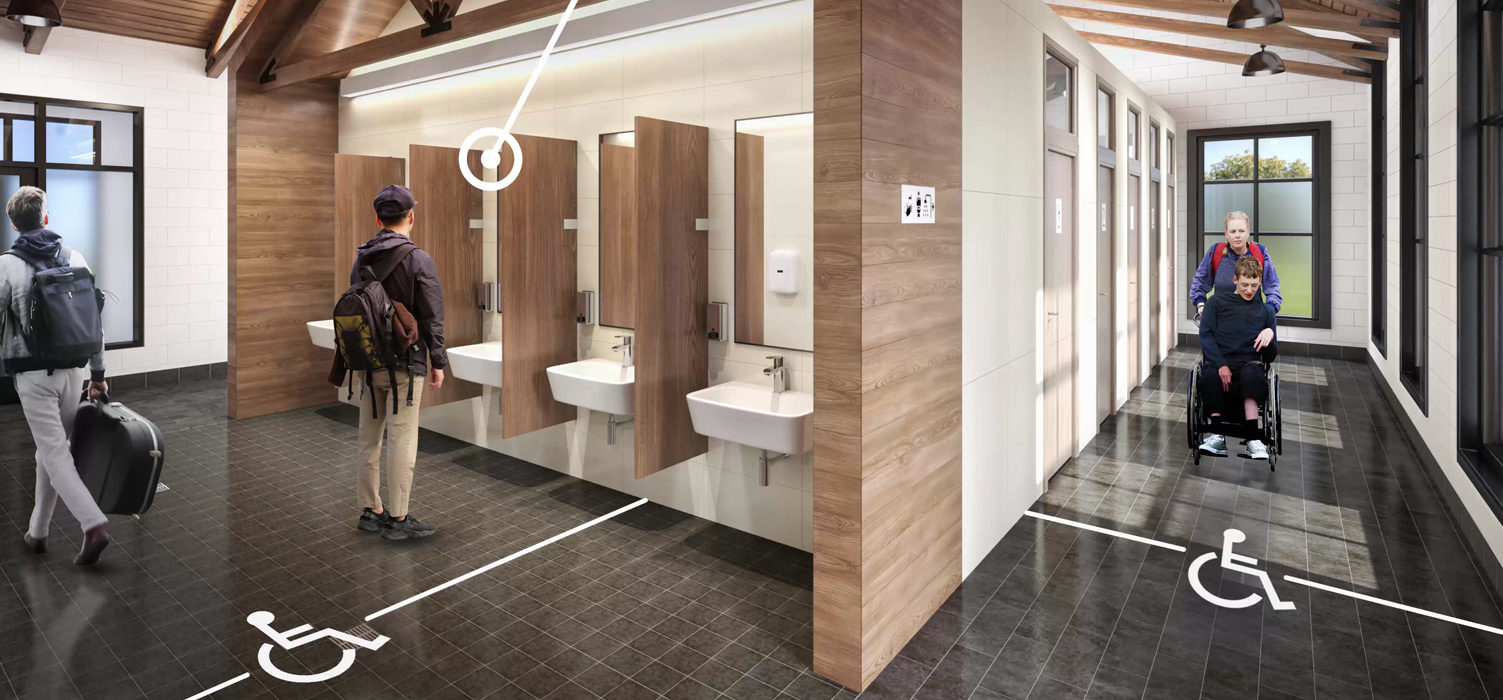
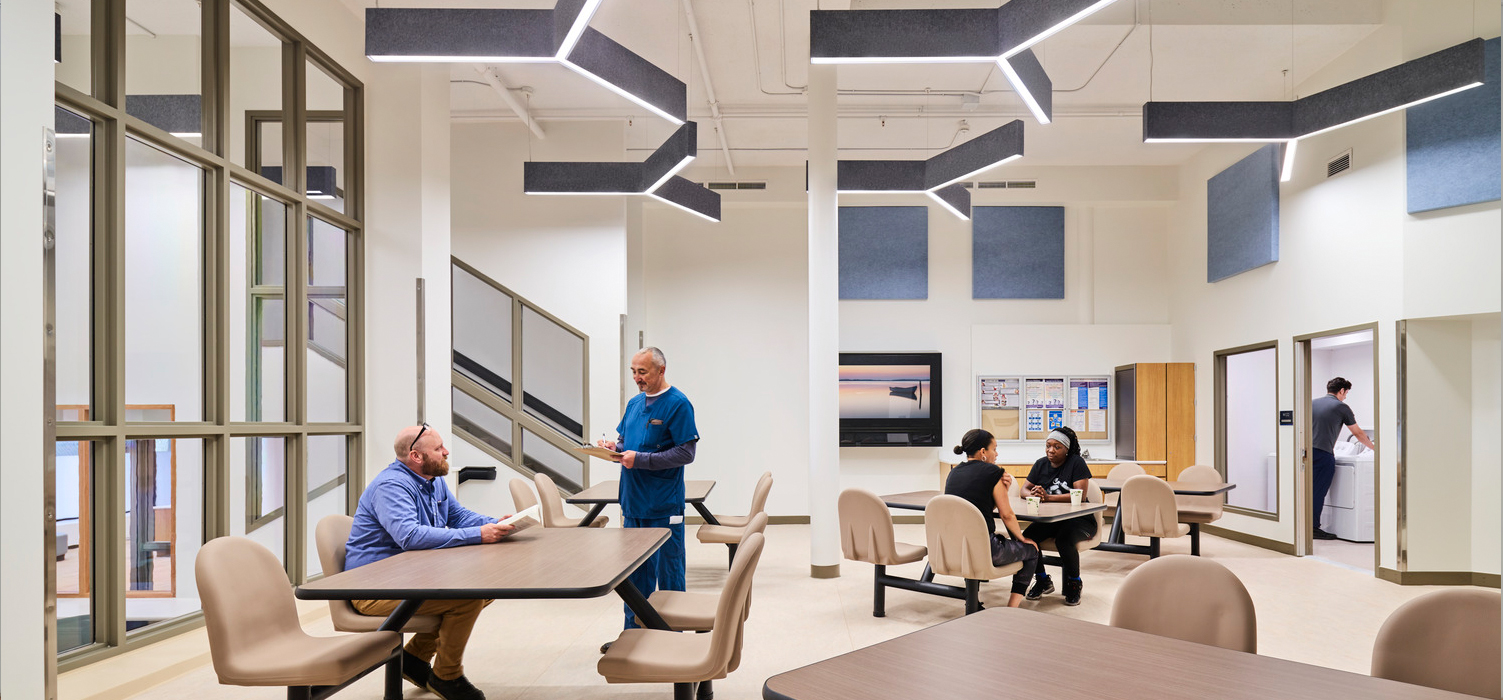
OMH Facilities
Pine Avenue
NHA Brooklyn Dreams
Queens Children’s PC
Children’s ASC
Elmwood
Broadway Market
Preservation
Vertical Transportation
Digital Concepts
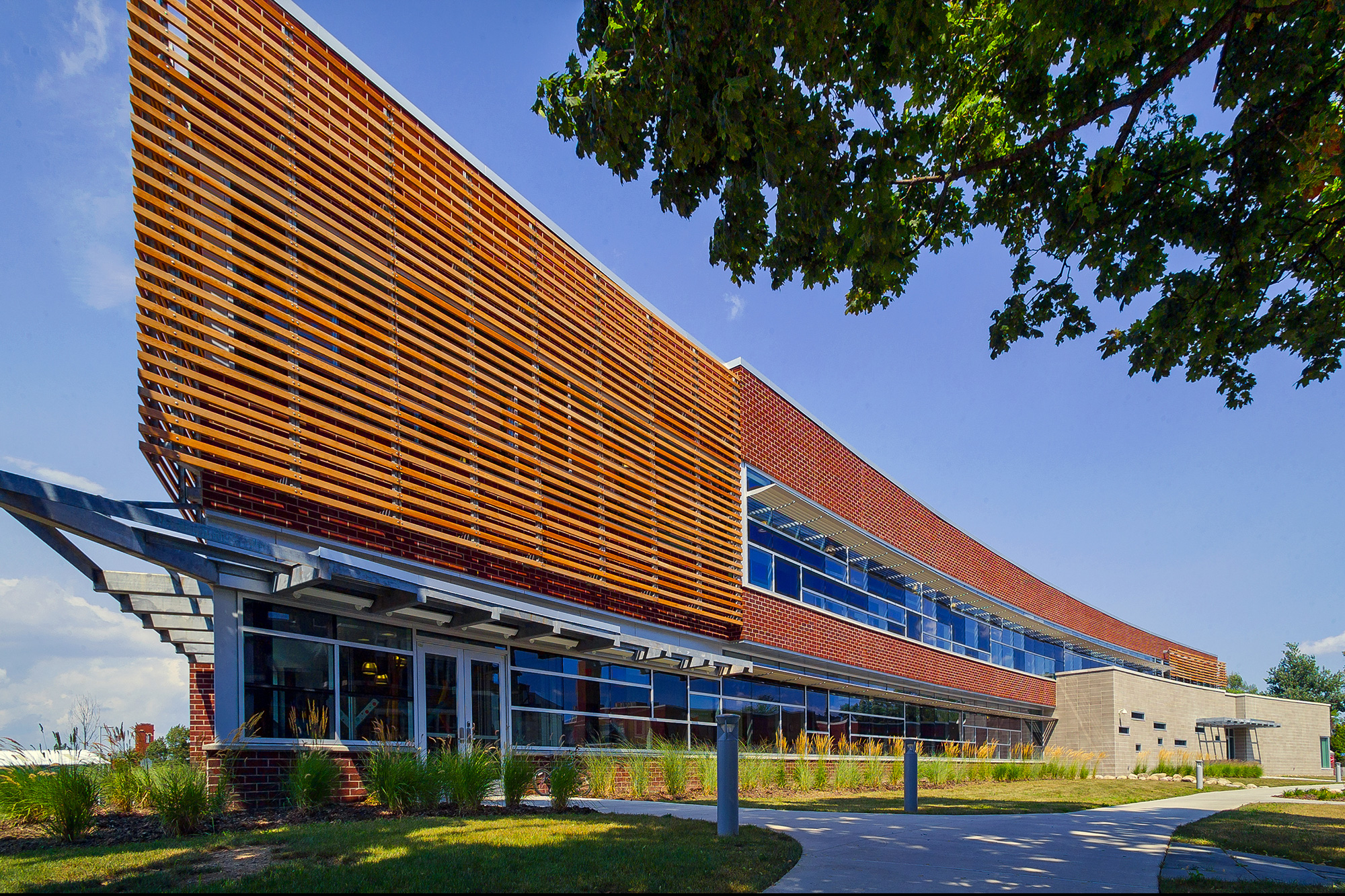
A|r has led the design team on a number of major projects at the Nichols School campus including greenspace and site circulation reconfiguration, athletic field redevelopment, and design and construction of the new Math, Science, & IT Building.
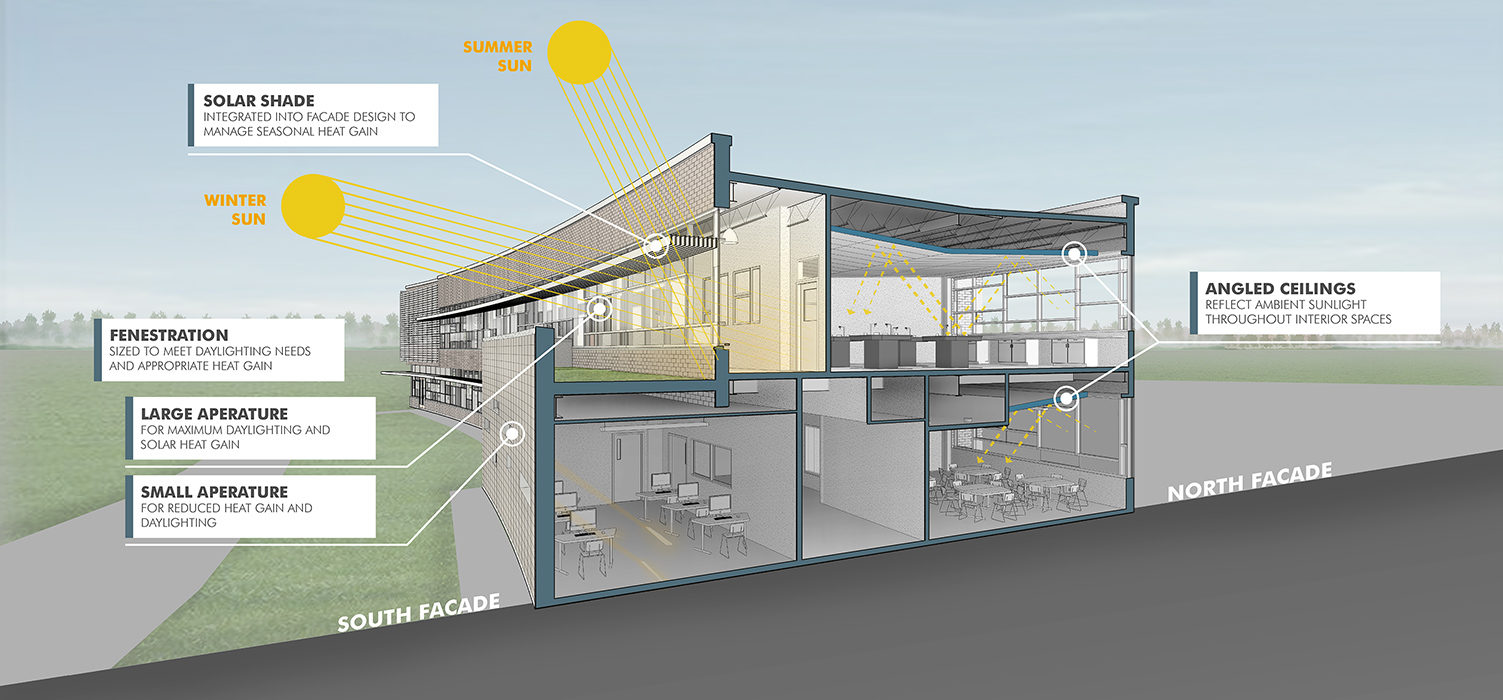
The new building design blends together the school’s mission of academic excellence and environmental sustainability. The unique design maximizes daylighting throughout the building. The long east-west axis, coupled with an intricately detailed system of louvers and overhangs, maximizes day-lighting while managing solar heat gain. A green roof, rain garden, energy saving MEP systems, low VOC finishes, and efficient building envelope are all incorporated into the design.
The Convocation Athletic Recreation Center is a signature building anchoring the far end of the main campus corridor. The 143,000 square foot LEED Silver certified complex provides a dynamic space for athletic, recreation and convocation activities. The facility includes an expansive field house, hockey rink, lap pool and fitness center. Large spaces are assembled, softened and joined with curved geometries successfully designed to minimize the massive volumes inherent in large sport venues. Sunlight is brought deep into the building through generous expanses of exterior fenestration and interior glass partitions, providing all of the necessary light for major program areas. The interior spaces are unified and wayfinding is made simple through the use of expansive window walls. The window wall design feature offers users views in and out of spaces, creating opportunities for student interaction and increasing the animated quality of the entire building.
Rockwell Hall is the iconic gateway building for SUNY Buffalo State and the centerpiece on campus. The adaptive reuse and comprehensive renovations to the former Burchfield Penney Art Center is comprised of expanded Art Conservation and Music Department program space. New laboratory, photography and library spaces have been provided for Art Conservation. The Music Department renovations include an acoustically designed and meticulously crafted 200-seat recital hall used for student, faculty and guest artist performances. Peer-to-peer collaboration is possible through advanced computer networking, allowing musicians to simultaneously perform with others around the globe in real time. General Classrooms have been renovated providing much needed surge space for the campus. Complete rehabilitation of the mechanical, electrical, and fire protection systems, life safety upgrades and energy efficient design strategies provided as part of this project reflect Buffalo State’s commitment to providing world-class learning environments.
Hallwalls Contemporary Art Center resides within the redeveloped Delaware Asbury Church, sharing impressively restored spaces with church owner, Righteous Babe Records. This internationally recognized art center includes dynamic gallery spaces with 16’ high ceilings, 60-seat performance and screening room, arts and media offices. A system of suspended and pivoting partitions allows for ever changing exhibit space customized to each installation. The gallery walls are held back to reveal slivers of the historic fabric such as wainscot, cast iron columns and art glass windows. The theater is equipped with sound, lighting and projection equipment for the screening of film and video productions as well as small musical performances.
This project received a design Honor Award from the Buffalo/WNY Chapter of the American Institute of Architects.
Hallwalls Contemporary Art Center resides within the redeveloped Delaware Asbury Church, sharing impressively restored spaces with church owner, Righteous Babe Records. This internationally recognized art center includes dynamic gallery spaces with 16’ high ceilings, 60-seat performance and screening room, arts and media offices. A system of suspended and pivoting partitions allows for ever changing exhibit space customized to each installation. The gallery walls are held back to reveal slivers of the historic fabric such as wainscot, cast iron columns and art glass windows. The theater is equipped with sound, lighting and projection equipment for the screening of film and video productions as well as small musical performances.
This project received a design Honor Award from the Buffalo/WNY Chapter of the American Institute of Architects.
Architectural Resources worked closely with BPC to design a flexible and professional work environment for job training programs. The design team placed great importance on creating an inspirational workspace flooded with daylight and views to the pastoral landscape. Large curtain wall windows and continuous clerestory fill the space with natural light and ventilation. Irregular geometry of the windows brings modern playfulness to the envelope of a simple warehouse.
As part of the billion dollar Buffalo Public Schools Reconstruction Project, A|r provided additions and comprehensive renovations to Public School 17 - Early Childhood Learning Center. The new Main Street Entry addition provides an inviting and safe entry for students, faculty and visitors. The former blank façade on the West Delevan Avenue side of the school has been dramatically transformed into an attractive composition with large cafeteria windows fronting on the street. Activity in the cafeteria enlivens the urban streetscape and students are afforded bucolic views of historic Forest Lawn across the street. The design palette of slate, metal and glass are used to compliment existing building materials in each of the two contemporary additions.
As part of the billion dollar Buffalo Public Schools Reconstruction Project, A|r provided additions and comprehensive renovations to Public School 17 – Early Childhood Learning Center. The new Main Street Entry addition provides an inviting and safe entry for students, faculty and visitors. The former blank façade on the West Delevan Avenue side of the school has been dramatically transformed into an attractive composition with large cafeteria windows fronting on the street. Activity in the cafeteria enlivens the urban streetscape and students are afforded bucolic views of historic Forest Lawn across the street. The design palette of slate, metal and glass are used to compliment existing building materials in each of the two contemporary additions.
The East Canal public space is an extension of the Canalside district, the celebrated terminus of the Erie Canal, and evokes the memory of the Main and Hamburg Canal. By design, the plaza very gradually slopes into the “canal” inviting the public to spontaneously enter the water. The multi-arched fountain, referencing the bridges that once crossed the canals, activates the water feature and provides children and adults with added attractions to play. The revitalization of this mixed-use public space is a major component of downtown Buffalo’s continued renaissance and a destination that celebrates its industrial past and rising future.
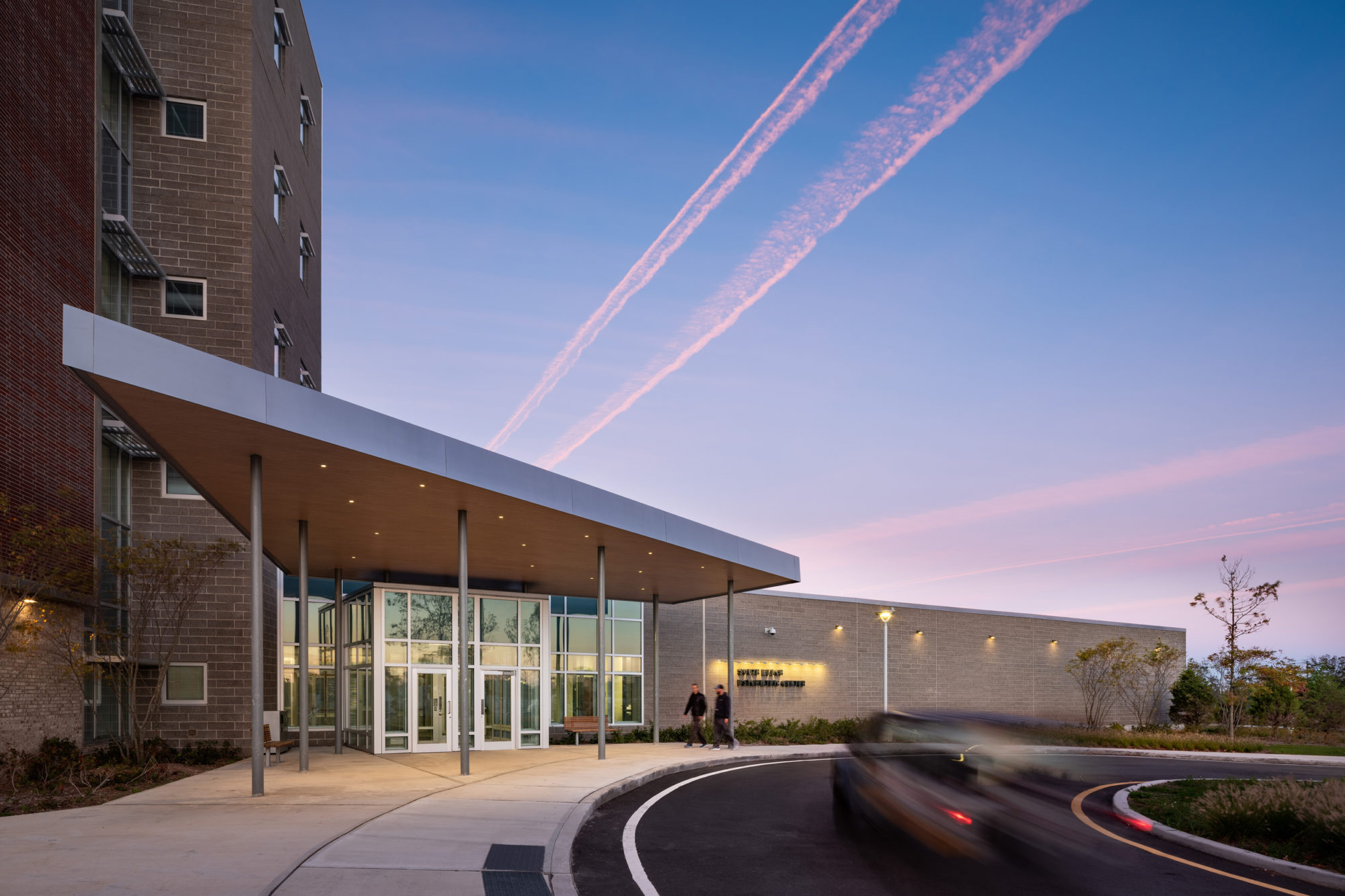
Completion of the South Buffalo Brownfield Opportunity Area Implementation Strategy and Final BOA Plan marks a critical milestone in a process that began in the late 1990s. This Plan establishes an overall vision for the area that includes economic and recreational development strategies for an area of the City that experienced industrial decline primarily due to the loss of steel related industries. The Implementation Strategy sets the stage for critical investment in the SBBOA by taking advantage of its numerous natural, cultural, and economic assets. The waterfront site is strategically located near the Canadian border and includes significant opportunities for global trade related industries. As the largest BOA in New York State, the Plan is an integral component for the revitalization of this land in the City of Buffalo.
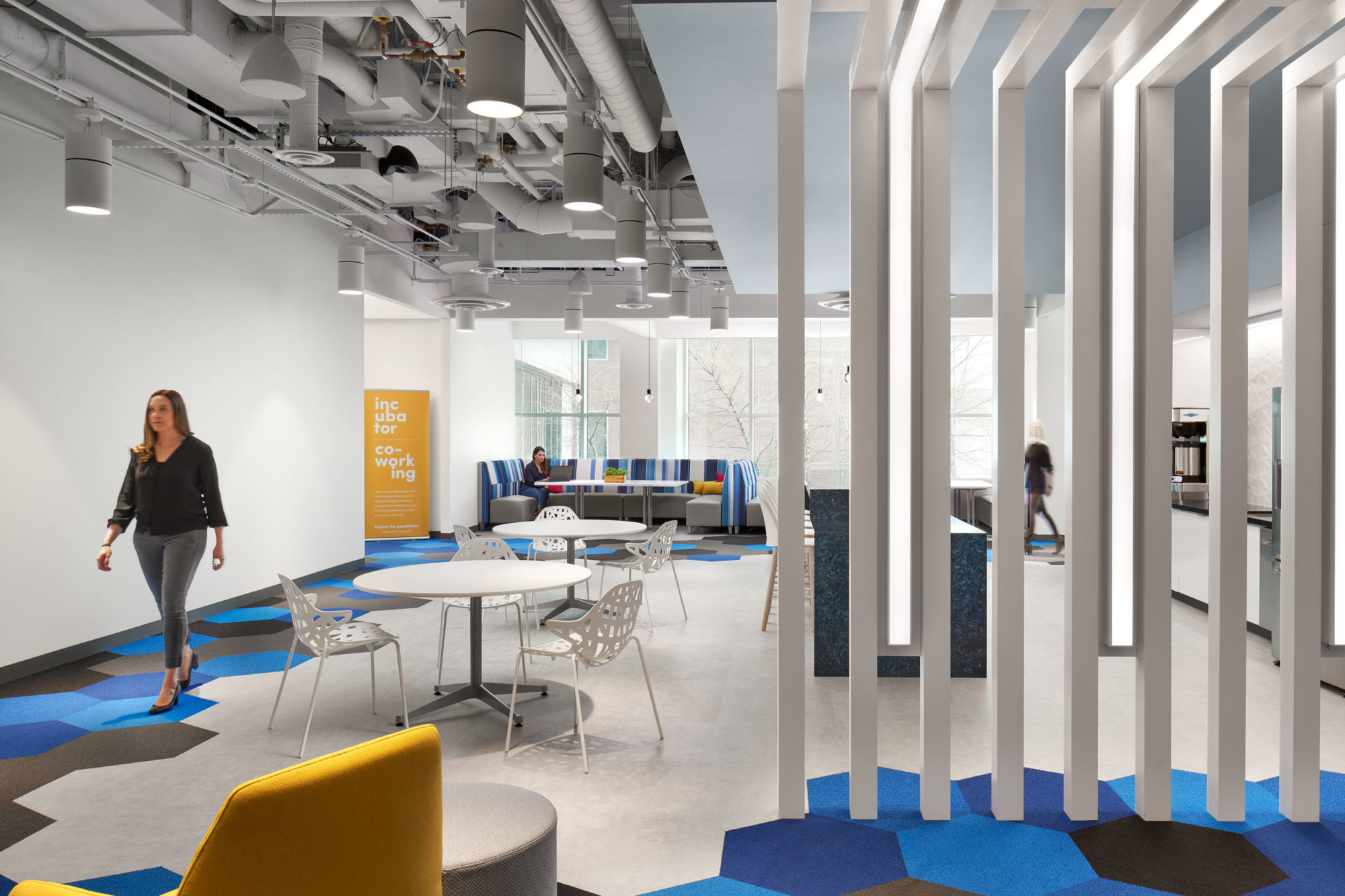
The adaptive reuse of the historic Larkin District U-Building, originally constructed in 1893, transforms the former industrial space into an innovative corporate office complex. Special attention has been given to preserving the historic industrial aesthetic of the building. Contemporary materials and color pallets are used to knit together the modern elements with the existing historic fabric of the building.
The transformation of the SUNY IT Campus Center Dining Facility provides a stimulating dining environment that promotes social interaction. The previously compartmentalized lobby, kitchen, servery and dining areas are now visually connected and abundant daylight fills each space. The campus community can now dine, engage with the chefs and experience the making of food. The highly efficient design of spaces meets program needs, increased occupancy from 350 to 600, and provides animated spaces with unified layers of very thoughtful interior finishes and furniture. Complementing the enhancement of the Campus Center architecture, a two-story addition provides a new home for mechanical systems. Moving the HVAC equipment, previously residing in a mezzanine above the student dining room, eliminates the constant noise from motors and rattling ductwork which fosters an environment conducive to conversation.
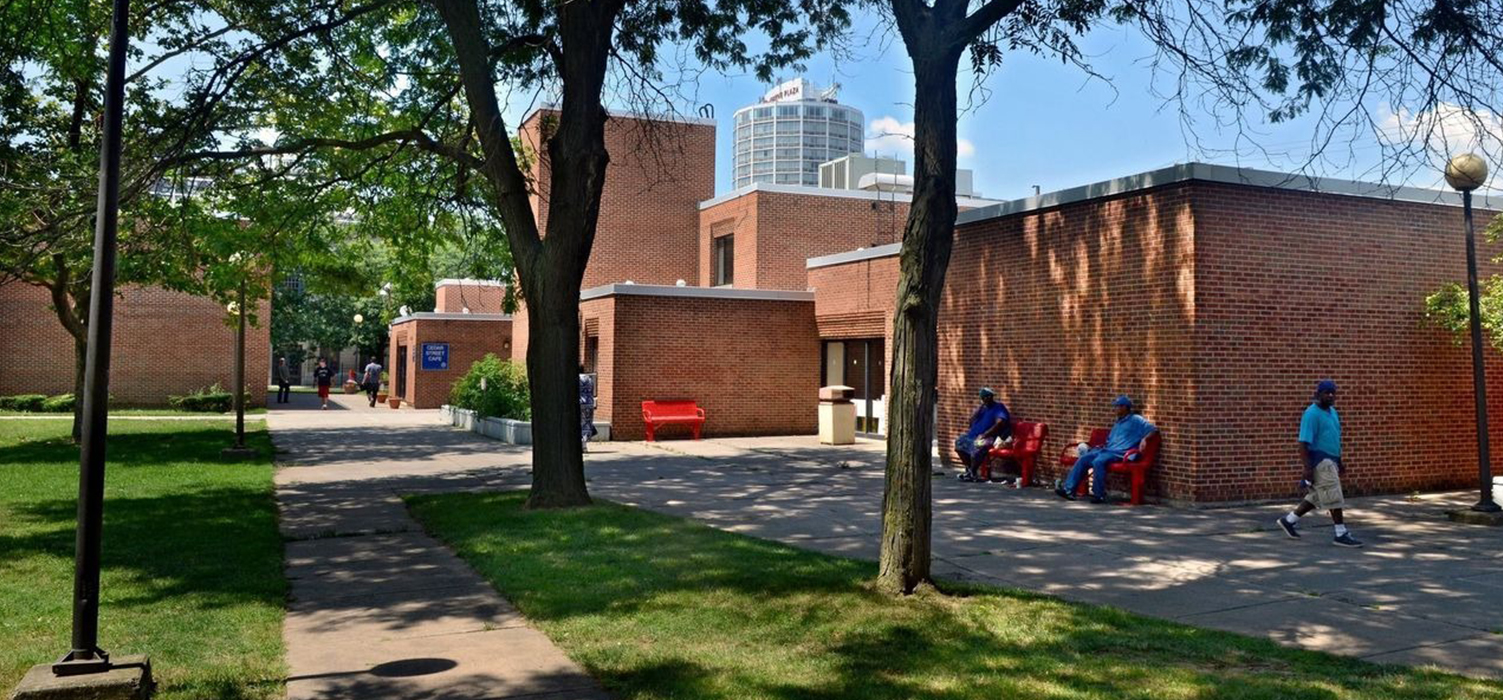
The Sound Recording Studio and Control Room teaching facilities play an integral role in SUNY Fredonia’s nationally renowned School of Music Sound Recording Technology Program. The studio spaces are located in Mason Hall adjacent to the Juliet Rosch Recital Hall. The American Institute of Architects award winning new sound recording studio design includes optimal architectural geometry and acoustical treatments for performance and sound isolation to and from the Recital Hall. The construction assemblies are designed to mitigate both airborne and structural sound transmission, providing adequate mass for ambient noise abatement and decoupling to eliminate structural noise. In order to meet the desired noise criteria, it was also necessary to remove and replace the entire mechanical system serving the area including the primary air moving equipment and terminal units.
An ambitious redesign concept for the Central Library entirely transforms the facility into a vibrant, welcoming and exciting place in downtown Buffalo. The Library is envisioned to be a beacon, a year-round community living room with optimal service delivery. Children, teens and adults are provided with a new dynamic environment where they can explore the variety of collections and access the most advanced digital technology and online resources.
The redesign includes the use of the existing facility in as economically efficient a manner as possible. Synergies were discovered between the Library and community partner organizations to create mutually beneficial financial relationships. The sustainable design transforms the quality of space maximizing transparency of both the interior and exterior of the building. Carving out portions of the floors adds to the dynamic quality of the structure while visually connecting spaces both vertically and horizontally.
An ambitious redesign concept for the Central Library entirely transforms the facility into a vibrant, welcoming and exciting place in downtown Buffalo. The Library is envisioned to be a beacon, a year-round community living room with optimal service delivery. Children, teens and adults are provided with a new dynamic environment where they can explore the variety of collections and access the most advanced digital technology and online resources.
The redesign includes the use of the existing facility in as economically efficient a manner as possible. Synergies were discovered between the Library and community partner organizations to create mutually beneficial financial relationships. The sustainable design transforms the quality of space maximizing transparency of both the interior and exterior of the building. Carving out portions of the floors adds to the dynamic quality of the structure while visually connecting spaces both vertically and horizontally.
The Ellicottville Library has become a significant community resource that supports the literary and educational needs of this thriving resort town. The building has been designed in support of life-long literacy, increased cultural and artistic awareness, and to provide opportunities for personal growth and enrichment.
The site is located on the edge of town and features a lush forested hillside as a backdrop. The wood and stone clad building reflect the character of this idyllic alpine setting while providing a modern, state of the art Library. The centerpiece of the building is a high entry and gallery space connecting the Library and the Community Room.
The Ellicottville Library has become a significant community resource that supports the literary and educational needs of this thriving resort town. The building has been designed in support of life-long literacy, increased cultural and artistic awareness, and to provide opportunities for personal growth and enrichment.
The site is located on the edge of town and features a lush forested hillside as a backdrop. The wood and stone clad building reflect the character of this idyllic alpine setting while providing a modern, state of the art Library. The centerpiece of the building is a high entry and gallery space connecting the Library and the Community Room.
The Buffalo Niagara Medical Campus is a regional center that has transformed a neighborhood into the home of one of the world's premier medical education, research and treatment campuses. A|r collaborated with The University at Buffalo, the Hauptman Woodward Institute, and Roswell Park Cancer Institute to design and construct a 100 foot long pedestrian bridge spanning over the primary corridor of the campus. The bridge design aesthetically marries the buildings it connects by responding to the form and material of adjoining facades while establishing the bridge's architectural identity. The transparent structure is composed of full height glass walls joined seamlessly together. The glass walls also extend above the top of the bridge to visually dematerialize the roof. These two design features contribute to both the integration of the buildings and the bridge while producing the visual weightlessness of the structure.
The Buffalo Niagara Medical Campus is a regional center that has transformed a neighborhood into the home of one of the world’s premier medical education, research and treatment campuses. A|r collaborated with The University at Buffalo, the Hauptman Woodward Institute, and Roswell Park Cancer Institute to design and construct a 100 foot long pedestrian bridge spanning over the primary corridor of the campus. The bridge design aesthetically marries the buildings it connects by responding to the form and material of adjoining facades while establishing the bridge’s architectural identity. The transparent structure is composed of full height glass walls joined seamlessly together. The glass walls also extend above the top of the bridge to visually dematerialize the roof. These two design features contribute to both the integration of the buildings and the bridge while producing the visual weightlessness of the structure.
Architectural Resources was the primary planning consultant leading several physician strategic planning committees within Kaleida Health in developing comprehensive inpatient and ambulatory plans for the relocation of Women’s and Children’s Hospital of Buffalo to the Buffalo Niagara Medical Campus. This extensive programming, planning, concept design and constituent outreach effort combined the expertise of Kaleida administrators, physician practice groups, the University of Buffalo School of Medicine and private sector developers. Today the effort has initiated over 750,000 square feet of highly integrated new construction on the Medical Campus.
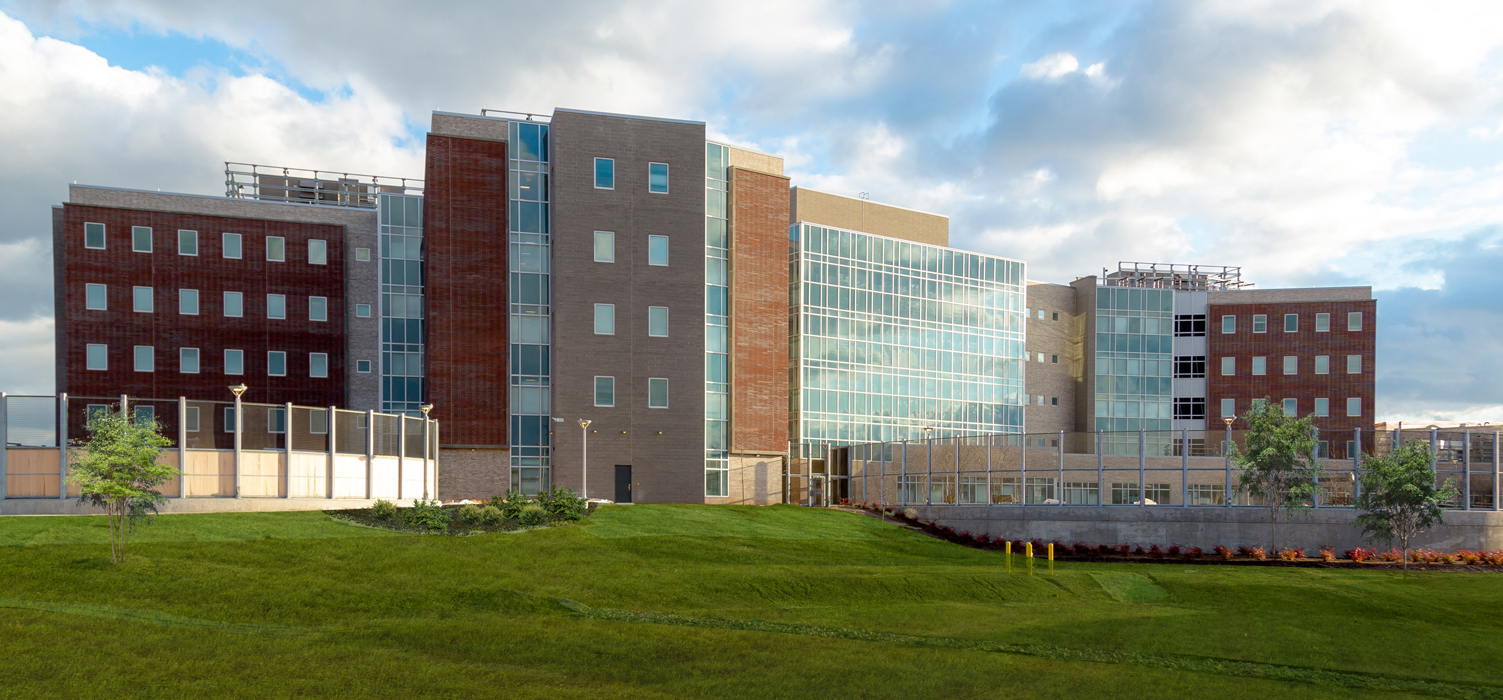
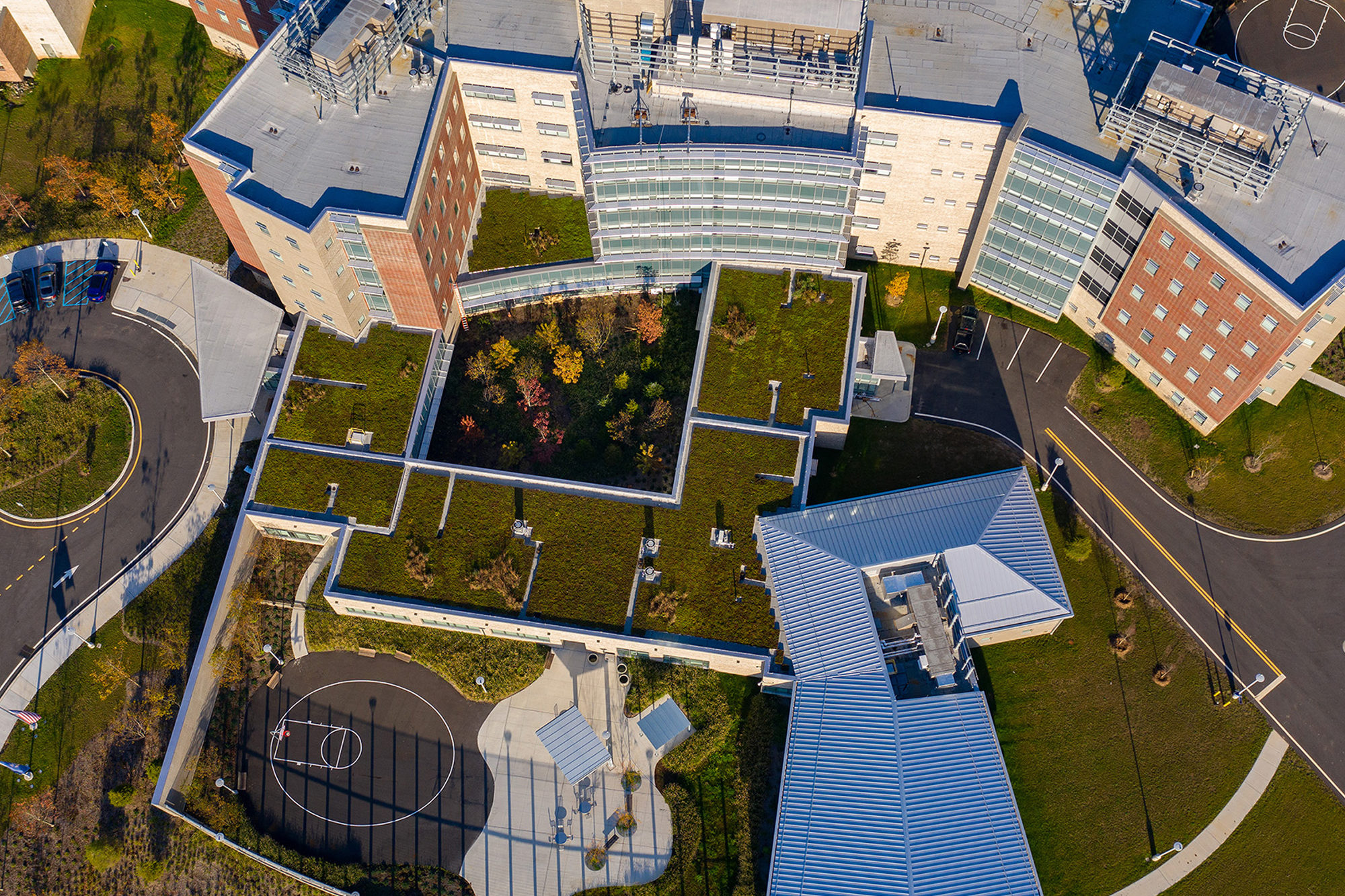
The Bronx Children’s Center is an 86-bed secure, inpatient youth psychiatric facility. The Children’s Center incorporates the latest clinical advances in family based treatment, staff and patient security, and suicide risk reduction all housed within a compassionate wellness environment.
Residential areas are designed to encourage small group socialization, clustering living and activity space with private bedrooms for each child. Units have clear sight lines for staff supervision, and direct connections to spacious outdoor recreation areas. The building includes a full academic program wing, gymnasium, auditorium, pool, health clinic, and treatment team areas.
The Bronx Children’s Center is an 86-bed secure, inpatient youth psychiatric facility. The Children’s Center incorporates the latest clinical advances in family based treatment, staff and patient security, and suicide risk reduction all housed within a compassionate wellness environment.
Residential areas are designed to encourage small group socialization, clustering living and activity space with private bedrooms for each child. Units have clear sight lines for staff supervision, and direct connections to spacious outdoor recreation areas. The building includes a full academic program wing, gymnasium, auditorium, pool, health clinic, and treatment team areas.
This newly constructed school for children with special needs is a community based component of the Queens Children’s Center. The Community Services Building provides an inspirational educational setting combining classrooms, clinic, counseling and administrative spaces.
Creative geometry and careful material selection come together to produce a striking building that serves many needs. Academic areas have been designed with a neighborhood concept, clustering classrooms with clinical staff offices. Interior and exterior spaces are laced together with garden-like themes and colors. The scholastic environment is enriched with excellent daylight and calming views.
This newly constructed school for children with special needs is a community based component of the Queens Children’s Center. The Community Services Building provides an inspirational educational setting combining classrooms, clinic, counseling and administrative spaces.
Creative geometry and careful material selection come together to produce a striking building that serves many needs. Academic areas have been designed with a neighborhood concept, clustering classrooms with clinical staff offices. Interior and exterior spaces are laced together with garden-like themes and colors. The scholastic environment is enriched with excellent daylight and calming views.
The Grant Street Community Residence is a dwelling for people who are transitioning from a hospital setting back into the community. The building design sensitively and unassumingly incorporates a 14 bedroom residence into a dense urban neighborhood through careful massing and use of contemporary vernacular building elements and materials.
Breaking from the traditional institutional feel of psychiatric facilities, the design focuses on use of natural, simple materials with plenty of solid wood for millwork and cabinetry. Ceramic tile and linoleum in lieu of vinyl products are used for flooring. Inside and out, generous use of color enhances the therapeutic environment.
The Grant Street Community Residence is a dwelling for people who are transitioning from a hospital setting back into the community. The building design sensitively and unassumingly incorporates a 14 bedroom residence into a dense urban neighborhood through careful massing and use of contemporary vernacular building elements and materials.
Breaking from the traditional institutional feel of psychiatric facilities, the design focuses on use of natural, simple materials with plenty of solid wood for millwork and cabinetry. Ceramic tile and linoleum in lieu of vinyl products are used for flooring. Inside and out, generous use of color enhances the therapeutic environment.
The City Wine Merchant anchors the corner of the newly revitalized 700 block of Main Street. Adjoining vacant properties at 727, 731 and 737 Main have also been brought back to life with similar projects designed by A|r and developed by Chris Jacobs at Avalon Development. An interesting mix of office and unique retail shops now collectively engage the community.
An urban commercial loft environment was created in part by exposing the previously concealed timber ceiling joists and red brick walls. Masonry infill was removed and a large window was restored adding valuable natural light and greater visibility to Main Street. Custom millwork was designed to accommodate the more intimate act of wine tasting in the context of a larger space where racks of wine are displayed.
The City Wine Merchant anchors the corner of the newly revitalized 700 block of Main Street. Adjoining vacant properties at 727, 731 and 737 Main have also been brought back to life with similar projects designed by A|r and developed by Chris Jacobs at Avalon Development. An interesting mix of office and unique retail shops now collectively engage the community.
An urban commercial loft environment was created in part by exposing the previously concealed timber ceiling joists and red brick walls. Masonry infill was removed and a large window was restored adding valuable natural light and greater visibility to Main Street. Custom millwork was designed to accommodate the more intimate act of wine tasting in the context of a larger space where racks of wine are displayed.
This state of the art Executive Conference Center replaced three smaller suites at the Coca-Cola Field ballpark. The new suite offers an unparalleled opportunity to combine business with recreation. It is used throughout the year for a variety of business activities, as well as entertainment and private parties.
The upscale bar area features an overhead bamboo canopy with custom furnishings. The conference area features a 12’ executive table with custom chairs, four 52” flat screen monitors, surround sound audio system with touch technology controls, and phone / video conferencing capabilities. Direct access to fifty dedicated balcony level seats allows patrons an opportunity to mingle inside or out.
This state of the art Executive Conference Center replaced three smaller suites at the Coca-Cola Field ballpark. The new suite offers an unparalleled opportunity to combine business with recreation. It is used throughout the year for a variety of business activities, as well as entertainment and private parties.
The upscale bar area features an overhead bamboo canopy with custom furnishings. The conference area features a 12’ executive table with custom chairs, four 52” flat screen monitors, surround sound audio system with touch technology controls, and phone / video conferencing capabilities. Direct access to fifty dedicated balcony level seats allows patrons an opportunity to mingle inside or out.
North Union Street is Olean’s main street, the center of commercial and civic activity and offers visitors their first impression of the City. The new street plan develops a cohesive design for a linear corridor that is safe, attractive, and comfortable for all users. Key design elements include infrastructure improvement and storm water management, strengthening pedestrian and bicycle accessibility, traffic calming, lighting, parking and enhanced storefront character. The streetscape design includes significant greening that is not only appropriate for the urban environment, but also ideal to mitigate storm water runoff.
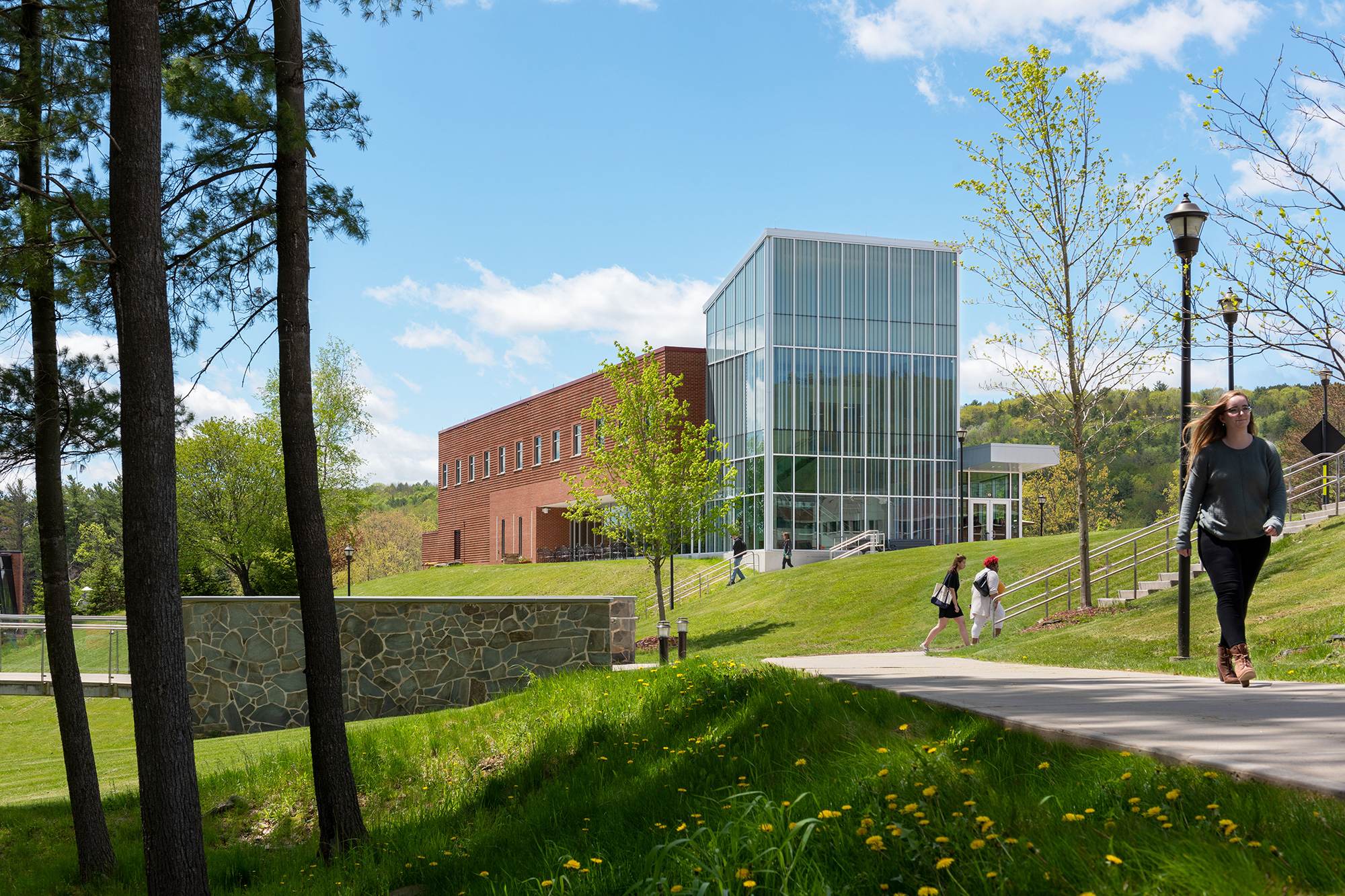
As part of a statewide initiative, the State University Construction Fund assisted campuses in developing Master Plans for the 21st century. The State University of New York at Canton has transitioned from a two-year to a four-year institution and witnessed a 60% enrollment growth between the early 1990’s and present day. Primary design concepts of the Facilities Master Plan include a main entry sequence allowing for a direct connection to the new mixed-used iconic Gateway building. This student services hub is located at the highest elevation on site, providing spectacular views of the entire campus. A new dining hall, provided in an adaptively reused facility, is located at the nexus of academic and student life axes. A roundabout has been provided for the Convocation Athletic Recreation Center, a facility that services not only the College, but also the local community and region.
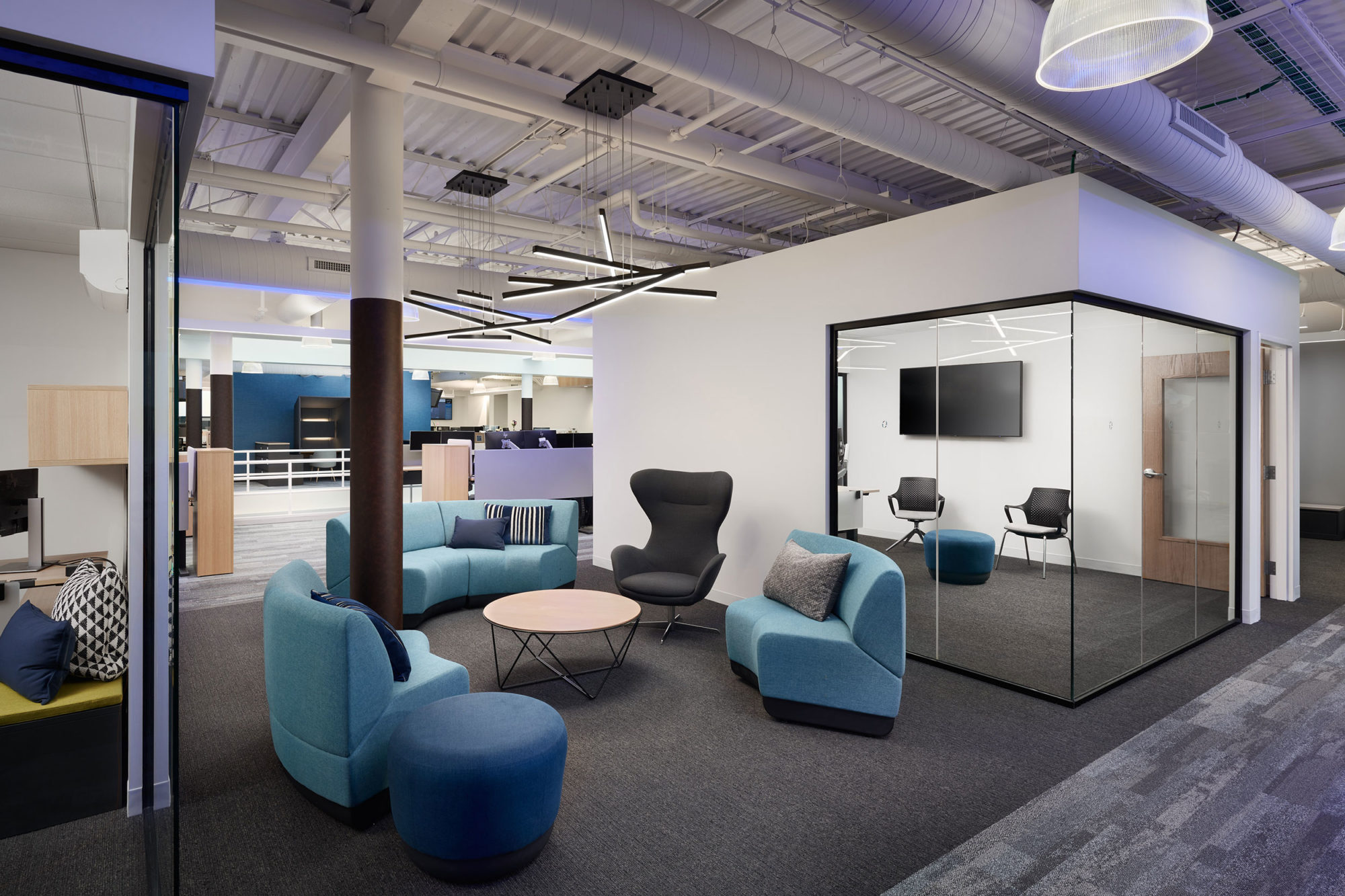
Expansive, high bay industrial space is now the site for the growing Research and Development Department at Praxair, a leader in the industrial gases industry. The industrial space has been transformed into professional offices space. Layers of transparency were used to enhance the experience of connection through the series of vast spaces. This experience is magnified in the new conference room where the glass wall projects beyond the existing structure cantilevering it into the open area of the atrium.
Harris Beach sought to relocate their suburban offices to the historic LCo Building in the Larkin District to better serve their clients and reconnect with the City of Buffalo. The firm resides on the Tenth Floor of the building in an exciting loft style environment.
A sophisticated reception area, historically themed conference rooms, and an exterior terrace set this law firm apart from the norm. The central reception and conference area features hardwood floors, cherry paneling, comfortable leather seating and a feature fireplace. Artwork adorns the walls of the adjoining office and support spaces. Exposed mechanical systems and concrete deck ceilings recall the industrial heritage of the complex that dates back to the early days of the Larkin Soap Company.
Harris Beach sought to relocate their suburban offices to the historic LCo Building in the Larkin District to better serve their clients and reconnect with the City of Buffalo. The firm resides on the Tenth Floor of the building in an exciting loft style environment.
A sophisticated reception area, historically themed conference rooms, and an exterior terrace set this law firm apart from the norm. The central reception and conference area features hardwood floors, cherry paneling, comfortable leather seating and a feature fireplace. Artwork adorns the walls of the adjoining office and support spaces. Exposed mechanical systems and concrete deck ceilings recall the industrial heritage of the complex that dates back to the early days of the Larkin Soap Company.
This progressive law firm realized their vision to create a contemporary workspace in the vibrant downtown Theater District. The 17,000 square foot space was designed to reflect the entrepreneurial culture of this firm. Playful color palette, geometry and lighting make for an attractive professional work environment while complimenting the contemporary artwork collection.
The former Stokes Seed Company Building has been a local landmark in the Historic Theatre District since 1911. Vacant for a decade, the building once served as a multi-level showroom for the sale of Ford Model T automobiles.
The Stokes project created three floors of loft style commercial lease space with spectacular views up Main Street. The exterior of the building was fully restored, including the entrance storefront system and it’s prismatic art glass clerestory. The art glass features patterns that were designed by Frank Lloyd Wright for the Luxfer Art Glass Company. The Buffalo Board for Historic Preservation and the Mayor’s Office of the City of Buffalo bestowed their highest award for Excellence in Preservation to this project.
The former Stokes Seed Company Building has been a local landmark in the Historic Theatre District since 1911. Vacant for a decade, the building once served as a multi-level showroom for the sale of Ford Model T automobiles.
The Stokes project created three floors of loft style commercial lease space with spectacular views up Main Street. The exterior of the building was fully restored, including the entrance storefront system and it’s prismatic art glass clerestory. The art glass features patterns that were designed by Frank Lloyd Wright for the Luxfer Art Glass Company. The Buffalo Board for Historic Preservation and the Mayor’s Office of the City of Buffalo bestowed their highest award for Excellence in Preservation to this project.
The Niagara River District has a rich history and is a community of great cultural diversity. Current efforts to strengthen this area have been successful and a strong sense of community commitment is seen in the many neighborhood organizations that are working collaboratively to further reinvestment strategies and actions. Additionally, the City of Buffalo is undertaking efforts to invest in the infrastructure of Niagara Street. Key components of the Master Plan include the transformation of Niagara Street into a complete street, an adjacent waterfront boardwalk, and well defined linkages to the surrounding mixed-use neighborhoods. One signature feature is the development of a prominent gateway entrance to the historic waterfront area of Broderick Park, which was an important access point in the Underground Railway and is a celebrated community area for African American Heritage Tourism Strategy.
The City of Fulton, NY Phase II Brownfield Opportunity Area Nomination Study includes the analysis of twenty-one potential brownfield sites across 530-acres on the eastern side of the City. A|r provided conceptual designs for strategic sites and the development of design guidelines for Fulton’s downtown core and the southern entrance to the City along Route 481. The guidelines illustrate preferred designs and techniques for future development of the districts. The goals of the guidelines are to improve the overall aesthetic character and provide visual unity throughout Fulton, provide a more cohesive built and natural environment, and encourage Fulton to develop as a more sustainable community. These guidelines offer land use strategies and development concepts by addressing standards for building massing and material choices, while also emphasizing walkability via heightened pedestrian experiences.
Commemorating the importance of the rich industrial and commercial heritage of Gateway Point, A|r provided a delicate merging of historical interpretation with feasible economic development initiatives to assist the City of North Tonawanda in maximizing the full potential of this eight-acre Erie Canal waterfront site. The collaboration of the project steering committee and our design team resulted in a mixed-use pedestrian-oriented development with generous park space, boat launches and heritage interpretation features. The plan enhances North Tonawanda’s vibrant downtown community, provides connections to waterfront parks and strengthens the district as a regional tourist destination.
The renovation of the Science 5 complex provides an advanced research laboratory facility reflecting the growth of the Biological Neuroscience program. The spaces are designed to foster collaboration while conducting highly specialized research. In order to accommodate strict research schedules, three distinct construction phases were developed to ensure uninterrupted operations of existing facilities. Specialty spaces include surgery and radiology suites, holding rooms, exam rooms, labs and research spaces. Cage wash operations are equipped with the most advanced equipment and high quality finishes provide impact and chemical resistance, seamless appearance and reduced maintenance. In addition to the sustainable architectural enhancements, comprehensive mechanical and electrical systems were upgraded to serve the building.
Architectural Resources assists in developing planning protocols, campus masterplans, and support service prototypes. The participatory approach taken with this work includes group design seminars, field surveys, interviews, and administrative programming sessions. This effort has produced long term campus plans with emphasis on flexibility, staffing efficiency and adherence to OMH/JCAHO standards. Recommendations for building and infrastructure consolidation opportunities for large hospital campuses allow for improved efficiency of space utilization, building utility systems and campus roadways.
The Pine Avenue Business District Urban Design Plan is a design framework for the Little Italy Niagara development. Design guidelines support the adoption of the Pine Avenue Special Zoning Overlay District and transform under-utilized Pine Avenue into a dynamic mixed-use district with a rich “old-world” atmosphere. The design concepts are based on a thorough evaluation of the physical resources on Pine Avenue, focusing on the unique elements of the District. The plan establishes “Little Italy Niagara” and Pine Avenue as a destination for shopping and other casual activities capable of attracting regional tourists and additional local business. The culturally themed development strategy includes protection of the Pine Avenue character and its architecture by creating a sequence of high quality public spaces and gateways.
A|r has designed five Charter Schools for National Heritage Academies in recent years. Three schools have opened in Brooklyn, one in Rochester and one in Buffalo. The Dreams School is typical of their highly progressive program that typically envisions a K-8 school for 700+ students.
A five story, 14,000 square foot brick and sandstone addition blends in harmoniously with the fully renovated 36,000 square foot existing building. The grand 2-story entry with adjoining glass block conference space creates an inviting and memorable connection to the surrounding community. It has been a privilege for us to craft environments that will support generations of young children as they pursue their dreams and achieve academic excellence.
A|r has designed five Charter Schools for National Heritage Academies in recent years. Three schools have opened in Brooklyn, one in Rochester and one in Buffalo. The Dreams School is typical of their highly progressive program that typically envisions a K-8 school for 700+ students.
A five story, 14,000 square foot brick and sandstone addition blends in harmoniously with the fully renovated 36,000 square foot existing building. The grand 2-story entry with adjoining glass block conference space creates an inviting and memorable connection to the surrounding community. It has been a privilege for us to craft environments that will support generations of young children as they pursue their dreams and achieve academic excellence.
Extensive renovations to the Queens Children’s Center transformed the formerly dark institutional environment into a safe and uplifting wellness center. The renovations to the lobby, academic, recreation, and residential areas focused on the playful use of contemporary materials and color palettes. A significant increase in natural daylight was achieved by the installation of new windows, raising ceiling heights at windows, and the installation of interior window walls bringing borrowed light into the corridors. The reconfiguration of the existing residential areas increased the openness of the units for better spatial quality and staff supervision. Aside from the modernization of interior environment, the renovations included new mechanical systems, new safety and security systems, code compliance, energy efficiency and upgrades to plumbing and electrical systems.
A|r developed a progressive architectural design and master plan for a proposed 5-story, 190,000 square foot new building for the WCHOB Hodge Avenue Campus. The project envisioned centralized outpatient care in a child friendly, state of the art environment. The building is inspired by it’s historic surroundings and seeks to integrate into the Elmwood Village context with great sensitivity.
The main facade features a substantial 2-story glass art wall. Select artwork created by children is featured along both floor levels. The integration of this work provides an inspired, hopeful and dynamic backdrop to a landscaped forecourt, with direct visual connection to the street and existing campus.
A|r developed a progressive architectural design and master plan for a proposed 5-story, 190,000 square foot new building for the WCHOB Hodge Avenue Campus. The project envisioned centralized outpatient care in a child friendly, state of the art environment. The building is inspired by it’s historic surroundings and seeks to integrate into the Elmwood Village context with great sensitivity.
The main facade features a substantial 2-story glass art wall. Select artwork created by children is featured along both floor levels. The integration of this work provides an inspired, hopeful and dynamic backdrop to a landscaped forecourt, with direct visual connection to the street and existing campus.
The Elmwood Village mixed-use district is bounded by the world-renowned Albright-Knox Art Gallery and SUNY Buffalo State to the north and the historic Allentown neighborhood to the south. The commercially vibrant, lively pedestrian streets and culturally diverse district is surrounded by historic residential neighborhoods. A|r collaborated with Forever Elmwood on the development of case studies that illustrate fundamental principles of design guidelines for the area. The case studies are an important component of the “Why Elmwood Works” presentation that demonstrates how the design guidelines and phased implementation reinforce the pedestrian-oriented character of the neighborhood while encouraging commercial revitalization. This design work supports the City of Buffalo’s initiative to legislate a new zoning overlay district that will promote desired patterns of development along the Avenue.
The historic Broadway Market was established in 1888 and is Western New York’s oldest public market. Covering an entire City block, the Market showcase's unique ethnic foods, farm-fresh produce and craft vendors. Today, the Market still serves as a primary food shopping venue and neighborhood anchor while also attracting visitors to a celebrated regional destination.
A|r designed and implemented multi-phased renovations to the exterior facades and the interior of the Market. Master planning and conceptual designs have been provided for the creation of a transportation portal and hub on Broadway. Iconographic signs, pedestrian access enhancements and streetscape improvements will enhance a visitor's arrival to the Broadway Market and the adjacent Farmers' Market.
The historic Broadway Market was established in 1888 and is Western New York’s oldest public market. Covering an entire City block, the Market showcase’s unique ethnic foods, farm-fresh produce and craft vendors. Today, the Market still serves as a primary food shopping venue and neighborhood anchor while also attracting visitors to a celebrated regional destination.
A|r designed and implemented multi-phased renovations to the exterior facades and the interior of the Market. Master planning and conceptual designs have been provided for the creation of a transportation portal and hub on Broadway. Iconographic signs, pedestrian access enhancements and streetscape improvements will enhance a visitor’s arrival to the Broadway Market and the adjacent Farmers’ Market.
Buffalo is well known and highly revered for its exceptional historic architecture. It has been our privilege to be involved in the restoration of a number of these significant buildings. We have stabilized the Twin Towers and the adjoining Medina Red Sandstone buildings of the former Buffalo Psychiatric Center. Acclaimed Architect H.H. Richardson designed this National Historic Landmark. The award winning restoration of the historic Stokes Seed Building served as the catalyst for the rebirth of the 700 block of Main Street. Along Millionaires Row we have restored the central courtyard of the Saturn Club, and assisted with grant funding for renovations to the English Tudor Richmond Lockwood Mansion. To the east of downtown we have renovated almost 600,000 square feet of space in the LCo Building, the former 1911 Larkin Terminal Warehouse that now anchors the emerging Larkin District.
Architectural Resources provides a wide array of vertical transportation engineering and inspection services. With over 60 years of vertical transportation system experience, the A|r VTE team employs an innovative approach to elevator and escalator system design. It starts simply with an extensive knowledge of building transportation systems as well as a comprehensive understanding of the projects interface with the buildings HVAC, plumbing, electrical, emergency power, fire alarm, fire protection, building management and security systems.
Our focus is, as always, on exceptional service, project management including trade coordination, cost control, project scheduling, and quality assurance. We are fortunate to provide these services to mostly repeat clients in the public and private sector, an indication of their continued satisfaction with the quality of our work.
Architectural Resources provides a wide array of vertical transportation engineering and inspection services. With over 60 years of vertical transportation system experience, the A|r VTE team employs an innovative approach to elevator and escalator system design. It starts simply with an extensive knowledge of building transportation systems as well as a comprehensive understanding of the projects interface with the buildings HVAC, plumbing, electrical, emergency power, fire alarm, fire protection, building management and security systems.
Our focus is, as always, on exceptional service, project management including trade coordination, cost control, project scheduling, and quality assurance. We are fortunate to provide these services to mostly repeat clients in the public and private sector, an indication of their continued satisfaction with the quality of our work.
A|r was one of the first architectural firms in the country to fully integrate state of the art Building Information Modeling (BIM) technology into our practice. Our three-dimensional visualization capabilities afford clear communication of our design and planning concepts. Design alternatives are developed expeditiously. Multiple variations in light, space, and materials can be studied. Once the direction is set, the model is further detailed to integrate the technical requirements of site, structure, and building systems. Looking forward we’re routinely evaluating new software and other technologies that may ultimately enhance building design and performance in ways not previously possible. A|r is committed to innovation. We will continue to lead in advancing the practice of architecture, and delivering projects of exceptional value.